
Spreading mulch or gravel can be a time- and labor-consuming task, especially if you empty a whole bucket and try to rake it out after it settles. When using your front-loader to spread mulch or gravel, you want to take your time and think about how the materials move.
Mulch tends to clump together, making it difficult to haul large amounts and spread them evenly.
Use your front-loader to load your bucket with mulch, leaving some empty space. Move the loader forward slightly and slowly creep along while allowing the mulch to fall from the front edge of the loader bucket. This technique lays a thin layer of mulch in your path, and you can repeat this process in rows.
When working around trees or in tight spaces, create a few small piles and use your loader to pull them back into a smooth layer by dragging them behind you with your loader flat on the ground. As you pull the mulch behind you, the back of the loader bucket acts like a squeegee to smooth and even out the surface.
Gravel flows freely from the loader bucket and does not clump, so you can haul larger loads. Let the gravel flow out of the loader bucket as you move, and do not dump it all at once.
Instead, tilt the loader bucket just enough to start the flow of gravel. Maintain a consistent speed, as stopping and starting can cause ridges in the surface. First, make a pass down the center, then make passes overlapping toward the sides. This technique spreads the gravel evenly, so you won’t have to go back to find and fix thin spots.
Regardless of your material choice, using a landscape rake will pull out sticks and debris as you go. For fine-tuning, a box blade or land blade can help you achieve an even surface. To clean up the edges, choose an angled rear blade. Make a quick pass along the edge of your bed to push the stray mulch or gravel back into place.
After laying down and leveling the material, use a box blade or land plane for gravel to achieve a smooth, even plane. The ideal tool depends on the size of the area being worked on and whether there are ruts, dips or holes that need to be filled in.
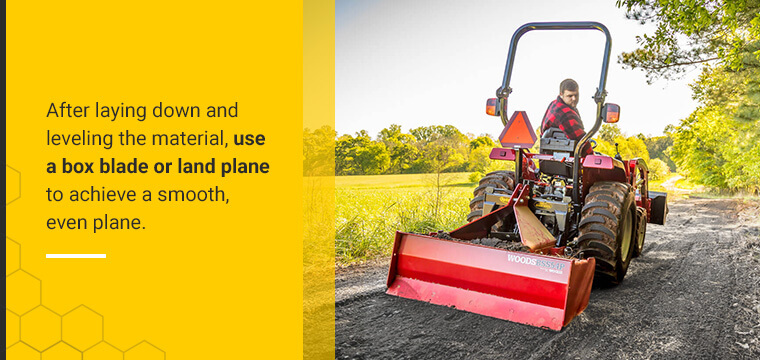
If you are working on a small area like a short section of a driveway, a box blade with scarifiers allows you to tear up the existing base and lay down the new material in one operation. You can also fill in ruts or low areas with the versatility needed to work on uneven surfaces.
For a longer stretch of straight driveway, a land plane would be better, as it holds grade over distance and produces a smoother finish with fewer adjustments.
While spreading the mulch and gravel is relatively simple, the finishing touches will give your mulched or graveled bed a professional appearance and help it last.
Unsure which attachments will fit your tractor? Visit any Holt Ag Solutions location in California or Oregon, or contact our team online for guidance.