Keeping your driveway in top shape is about more than appearance. A well-graded gravel driveway is safer to drive on and prevents damage to your vehicle. Ruts, potholes and edge erosion can develop in poorly maintained driveways, allowing standing water to accumulate after rain.
Thankfully, you only need a compact tractor and a box blade attachment to restore your driveway and make sure it stands the test of time. In this guide, you’ll learn the step-by-step way to grade and crown your gravel driveway with a box blade, and how to fix potholes and stop water damage for good.
When tackling driveway issues, you’ll need two tools to get the job done right with your compact tractor — the box blade and the land plane. While it makes sense to use a land plane for driveway smoothing and leveling, box blades tend to be a much more versatile and efficient option for grading and crowning. Using these attachments correctly will get you the best results for your driveway.
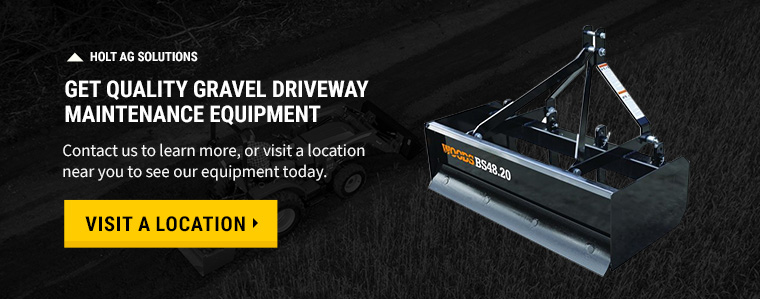
The box blade, also called a box scraper, is a heavy-duty tool specifically designed to repair and reshape surfaces. Most importantly, this attachment has features called scarifiers — stout teeth that can dig into hard-packed surfaces, letting you quickly break up compacted gravel and loosen materials. It lets you loosen deeply embedded ruts and prepare your driveway’s surface for a big reshaping job. Its closed-frame design is also perfect for moving large volumes of material, so you can fill deep depressions and create a proper crown.
Using a box blade for driveway work makes the most sense, especially when you’re doing a full regrade, fixing larger issues or building an entirely new profile.
The land plane is primarily for finishing. While it may handle smaller leveling tasks, it’s best for smoothing a surface that’s already graded or for improving driveway drainage to prevent future issues from developing. Land planes are excellent for light gravel redistribution, removing small bumps and keeping the surface even. The attachment can quickly shave off high spots while filling in the low ones for a uniform, smooth finish. Use a land plane after you finish the initial heavy work with the box blade.
A rear blade is a versatile tool that can pull gravel from the edges. It can also handle light grading work and clear snow. While a rear blade can create a crown when angled, it won’t carry material like a box blade. Its blades are best for final leveling and smoothing, giving you an attractive result.
While driveway maintenance may seem like a significant undertaking, these simple steps will help you easily grade a gravel driveway with a tractor and get a professional-quality finish that lasts. We’ll walk you through the process, including compact tractor driveway grading tips to create a resilient surface and prevent water damage.
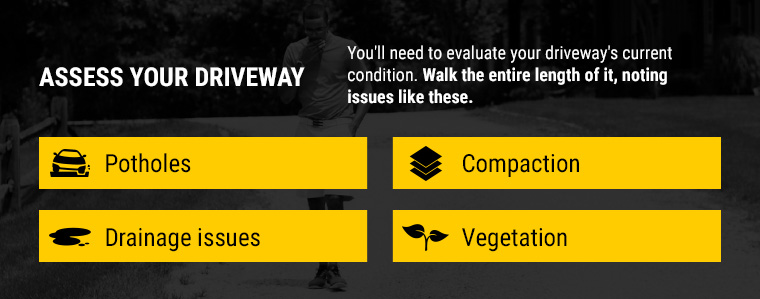
Before starting your project, you’ll need to evaluate your driveway’s current condition. Walk the entire length of it, noting issues like these.
A thorough visual inspection will let you highlight the problem areas to concentrate on for the optimal outcome.
Thoroughly dig out deep holes, remove loose dirt, mud or organic material, then fill in the excavated area with layers of new, quality gravel. Compacting each layer with a hand tamper or your tractor tires before adding another will ensure your material lies properly and give you a stable base.
Next, prepare the entire driveway surface. Set your box blade’s scarifiers to the correct depth — typically enough to break up the top two to four inches of compacted gravel. Engage the scarifiers and make several passes over your entire driveway. Focus on loosening the top layer of the material, which will allow you to create a consistent bed of gravel to move and shape into a proper crown.
A crown is the gentle slope that starts at the center of the driveway down to its edges to shed water. Without a crown, water will pool, reach the sub-base and eventually cause washouts and potholes. Your slope should be about a half-inch of drop per foot of width to allow water to flow off without eroding the surface. Here’s how to crown a gravel driveway.
After building the crown and finishing the initial shaping, it’s time for the final touches. To do this, raise the scarifiers completely out of the ground and level your box blade flat. Then, make several final passes over the entire length of your driveway. These should be shallow and barely skim the surface, smoothing blade marks and feathering the edges to get a clean look.
You can also use the back of the blade by rotating it 180 degrees, or slightly lift the front edge to gently float over the surface. Your goal is to compact and polish the top layer for a smooth, professional-looking finish. Continue making gentle passes until your surface is uniformly smooth with a perfectly shaped crown.
Driveway grading with compact tractors and high-quality attachments will make the job feel effortless. Holt Ag Solutions is your expert partner to equip you with a perfectly matched tractor and implement package. We proudly offer compact tractors from trusted brands like Fendt, Massey Ferguson and Kubota, all known for their reliability and performance. For instance, Fendt tractors come standard with Gold Star and Gold Star+ Customer Care Programs, providing unparalleled support and peace of mind.
You can also choose from high-quality box scrapers in a range of models, from standard-duty models up to 45 HP to medium-duty models ranging from 40 to 65 HP. Our experts will help you choose the ideal tractor model, ensuring it can easily handle the specific implement models.
Contact us to learn more, or visit a location near you to see our equipment today.